Thursday, January 31, 2008

Singapore 'for free'


Because our flight from Cambodia came in late, we missed our SFO flight, so Singapore Airlines gave us a free hotel. What an amazing contrast. Night before last, we were in the two-block tourist-focused 'downtown' of Siem Reap, somewhat dusty, tacky, and loud, with partying budget tourists; last night, we were in the never ending sophisticated downtown that is Singapore, with blazing holiday lights for Chinese New Years that were as bright as Las Vegas and as much action on the late night streets as Las Vegas has.


For dinner last night, we went to Clark Quay. Imagine if fisherman's wharf or jack london square were really a place locals liked to go; imagine that it all felt safe, light and bright; imagine if your choice of food there was everything and anything tasty, if you have the money; imagine that it went on and on on both sides of a river, with restaurants that have modern styling that is also a bit funny, kind of like being in a set for The Jetsons, and that brightly lit river boats went chugging up and down the river full of holidaygoers. Imagine it has liberal amounts of clean public toilets with automatic self cleaning and with airblown hand driers that dry your hands from all sides (this is ultra clean singapore, after all). Imagine everything is so much more up to date than our country, that for the wealthy everything is automatically debited practically by walking around. It's quite amazing here. And everyone seated at the tables or waiting tables is so stylish, and style-conscious. We were definitely surrounded by 'the beautiful people' of this generation, all so apparently rich (more on this later)

The specialty of Singapore is a fresh crab cooked in a thick spicy yellow sauce, called chilli crab. We went to a Chinese restaurant which is on the riverside, on an elevated dais, with overhanging white suspended round canopies that are sort of shaped like flying saucers. Because chinese new years is 6 days away, from every eave hang red globe shaped paper lanterns with gilt patterns, aglow with light. (if you want to see our restaurant, check out http://travel2.nytimes.com/2006/01/01/travel/01going.html)

On the river across from us, we could see a park where people were flying remote controlled 'kites' that are lit up with neon lights so they also look like flying saucers, they are blue and red or green and red and they swoop around like the bat rays at Monterey aquarium. Apparently they are for sale over across the river somewhere but we never did check it out.
At this restaurant we ate: freshly flash fried squid, which actually didn't seem like this at all, their coating was a delicate eggshell thin brittle that was both spicy and sweet and they were the size of cashew nuts and they seemed to have no interior texture at all. They were like nothing I have ever eaten. Then we had the Chilli crab, for this we had huge aprons brought to us and fresh changes of finger-washing water every few minutes; and we had some light thin noodles with prawns as a side dish. We had local beers and red wine. It was really good. It was not cheap, we had to charge it as we are out of money, it was about $154 singapore dollars which is about $120 US. Definitely our most expensive venture on this trip. They gave us a coupon, $50 off if used within 3 months from January 31 2008, any9one going to singapore soon?

For the rest of our 24-hour stay in Singapore we ate at the 'food hawkers'. Imagine if a 'food court' were actually a good thing, a gourmet experience where everyone competes to have the best food. Imagine if every 3 or 4 blocks in the downtown there was at least one, with at least 20 restaurants each. Every imaginable chinese, indonesian, indian, ice cream, european food seems represented. In the morning we ate some dim sum at a chinese food hawker with probably 60 little stalls. At lunch we ate at a famous one in a large wrought iron antique market building that now instead of selling stinky fresh fish, has 250 gourmet food choices. Inside are hundreds of small tables, which everyone shares; to reserve your seat you toss a packet of tissues on the table top and everyone respects this, while you go off to find your food, drink and dessert while answering your cell phone and making deals. This type of meal is cheaper, about $6 singapore buys a lot of food and it's all good. Craig had a noodle/charsiu/steamed greens for singapore $3.50, I had $6 of dim sum.

We were unbelievably lucky to be 'stranded' in Singapore at this time, because of the run-up to the year of the Rat. All over, red lanterns and pictures of the equivalent of mickey mouse are up. In chinatown, endless stalls are open selling red and gold decorations, lucky cookies, lucky red scrolls, lucky new clothes, on top of the other really good but costly antique stores and very tacky clothes stores. Singapore is no bargain, it must cost a lot to live here and it is quite odd since Malaysia and Indonesia, so close, are so much less well off and consequently such an easier place to visit, for the budget minded. On the other hand, it was great to experience clean glitz for a while, and to see what might be coming our way here in the US some time. Singapore Air put us up in a neighborhood about 2/3 of the way into town, in the equivalent of Millbrae, so we took a number of ten minute cab rides to get into the center and had a good time talking with the cab drivers about their city. It's clear after a while that (as you'd expect) not everyone in this city is rich, the cabbies take home is about $50 singapore a day and the food stalls and bathrooms are constantly being cleaned and cleared by quiet somber looking malaysian looking people. But outwardly everything seems so prosperous. We have no idea where these poorer folks live or how since outwardly in Singapore all you see is tidy, massive apartment building and shopping complexes. Lots of things for sale, not many of them appealing to me and Craig.

We also had a great time in Chinatown , because today is the Friday before the school breaks for new years, I guess. Anyway, every preschool and elementary school class seemed to be out on field trips. We saw lots of classes out with teachers exploring the ancient chinese temples scattered here and there, listening to 'why the roof tiles are made to look like bamboo, because they are strong, long lasting, flexible and useful' and 'why the emperor's robe always has a dragon a tiger and a phoenix' and stuff like that. The kids were not all ethnically Chinese, many were Malay or indian. Each group had different school uniforms. We liked seeing the variety of teachers like a male sikh in a turban and a chinese-accented woman and lots of moms around as well. The kids were clearly reliably well behaved, good at quickly lining up by twos.

We had so much fun in the Chinese New Year markets, and escaping into the endless shopping centers. From every bank and shopping mall entryway air-con blasts out. Air is clean, tapwater is pure. This is an energy intensive city that's for sure!

We also got a special bonus even though we only had time to walk around the 'chinatown area'; we went into the hindu temple called Sri Mariamann and it was great. This was built in 1825, it is full of multicolored hindu deities in many shrines. Its temple areas have open sides. Many quite beautifully dressed hindu ladies dressed in gold bordered saris were preparing small food offerings, many had red bindis in between their eyes and red dots on the hairline as well. In front, priests were doing some ceremonies involving flames and candles. In the temple, people were lined up and all in prayer with hands together whether standing or kneeling. On the group, there were at least 3 musicians, one playing a horizontally held drum striking it on either end, one playing a kind of drone like a bagpipe and another with the melody. In the open patios, little pigeonlike birds with lovely white spots on the wings took off and landed, while people in Indian clothing milled around. This in the middle of chinatown and near a mosque.

We also went into several chinese temples and picked up some buddhist literature. One that we went into is apparently the home of one of the Buddha's teeth; it has a large central buddha about 16 feet tall, and the walls are full of niches each with many small buddhas or boddhisatvas carrying different motifs (conch, lotus, cell phones) and in front of each was a row of five small offerings including fruit, shells, flowers, a small mount meru like pagoda and something else. Because of the lunar new year, the walkways were lined with small pink-flowered trees hung with little year of the rat cards with the little mickey mouse motif and gilt and I suppose childrens names on them. There were several rooms with buddhas and many walls with the mini buddhas in niches. Would have liked to have understood more about this place.

We did learn, to participate in the new year here you need a LOT of cash to give out red envelopes to younguns and buy new clothes and food. So-- a lot of people choose this time to leave town! just like some of us ditch christmas....

Wednesday, January 30, 2008

Wild Parrots and Tame Elephants in Angkor


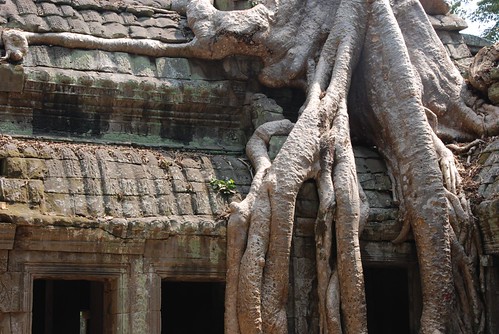
I've never seen the movie, "Tomb Raiders", but it was filmed at the Ta Prohm temple (at least part of it) here at Angkor. In this temple are the 'Fromager' trees, with the great roots snaking their way down the temple walls, in and out of temple windows and threading their way through the stones. It is actually these tree roots that cause the temples to tumble down into piles of rocks.


For our last full day here we went out to the Ta Prohm for sunrise. The first time we were here, we came around 8am and the hordes started arriving soon after. We knew that we would be practically alone in the wee hours. We weren't disappointed. We had the temple practically to ourselves.


It's so nice just to sit on a stone, overlooking some amazing jungle/temple scene and listen to the jungle wake up. The suprising thing this morning was that we heard what we could swear was a flock of parrots flying from tree to tree. I thought that parrots were only in the western hemisphere, but here they were and the guard confirmed that they were indeed parrots. They were having a great time and were very loud.


Outside the temple we had another nice breakfast in one of the little stands. Amy had pancakes with lemon sugar and I had stir fried chicken and rice. We washed it down with coffee with condensed milk. We had a nice conversation with some of the little postcard sellers as we ate. Amy brought some postcards of San Francisco, which we handed out to the kids. They looked at the Golden Gate Bridge with wonder.


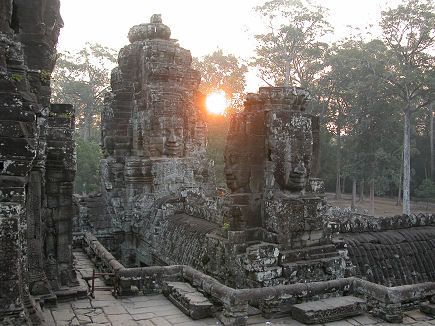
From here we again went to the Bayon temple, which is in the middle of the huge Angkor Thom temple (which is 4 square kilometers!!!). This is the three level temple with 54 towers with four faces on each tower of Jayavarman VII, who built this temple. Unfortunately, we got there a little late in the morning and many loads of tourists were coming off of their buses. We saw how they all went...they were unloaded at the east gate of the temple, herded around the southeast corner, where there are some nice bas reliefs, herded up to the top, where the towers are, and then sent down to ground level on the north side, and onto their buses again. EVERY tour group did this and it was only the folks who were on their own, or with a private guide, that took a different course.


So I can't say this enough...DO NOT TAKE A TOUR HERE, COME ON YOUR OWN. Okay, enough said about that.


Right across the street from the Bayon is a little Buddhist temple and we were lucky enough to see it when there was a little ceremony going on. There were 6 musicians playing some Cambodian music and a monk or two doing whatever monks do. The music was very magical, especially with the Bayon as a backdrop. But then we saw something really unusual. Six elephants were marching down the road with some Japanese tourists atop. This is how tourists got around back in 'the day', but today you don't see all that many elephants.
So tonight is our last night and we are just hanging out in Siem Reap. Maybe we''ll have some Khmer food for our last meal here, which is quite tasty. Tomorrow it's a 26 hour flight home. I'm very happy to go back, although this has been a great trip. I'll be uploading our own photos to the blog next week (the photos here are just some I found on the web). More soon and thanks for reading our blog.

angkor evening (last night in angkor, day 5, by Amy)

Today many good things happened, I'll start from tonight and work backwards. It has just gotten dark and we were just walking around our neighborhood around the Borann hotel through back streets and most recently were in front of the Royal Residence where monks were holding a small ceremony with chanting and music, and everyone was buying lotus blossom and young coconut offerings with incense, or fragrant tuberoses or other fragrant flowers and coming in and out this elegant shrine the size of a garage, leaving their shoes with the shoe watcher and getting their small children balloon sculptures or ice creams. Light streamed out from the small wat and music filled the air.

In our neighborhood, we walked through some apparently middle class areas on one lane streets with two story houses with nice fenced yards, and also along the river where dwellings were more crowded, more makeshift. Everywhere people especially children were very kind, all the children were calling out hello, and people especially the women met my eyes with nice smiles in return. It's a pleasure to feel people's lively curiosity and general welcoming spirit. Before we came to Cambodia we watched a lot of backpacker travel shows and this was something often commented on. People sure don't have much and sure have it hard but but they don't seem to have anger at outsiders at least not visibly because of this. Amazing since so much has happened in Cambodia. Earlier today our tuktuk driver gave us an unplanned stop at Wat Thep Pothirong, so that we would be sure to see the memorial there to pol pot, complete with small pagoda like structure containing carefully stacked leg bones and skulls and a wall with photos of many of the people who ended up dying there. I was actually very happy that he took us there, not that we didn't know about it but that it was so important for him that we go there.

(Later on when we took a cab ride to the airport, it turned out our cab driver is the younger brother of our tuktuk driver, by 7 years; he told me that they had both lost their dad, and an older brother, to Pol Pot, and that the brothers and mom had spent time in Thailand; and that the tuktuk driver brother had worked a long time in Bangkok before he was able to return. The younger brother speaks better English, has a car not a tuktuk, and is much less shy; he seemed more like the younger Cambodians we met, whereas his older brother was definitely more self contained and pretty self effacing and took a while to get to know us before sharing things or offering suggestions).

This afternoon had a very nice feel for us. We have had a chance to spend a lot of time in the temples, and as the week has moved from Friday Saturday Sunday and into the week, it seems that the volume of people has dropped a lot; it may be that the weekends a lot more people who work in Singapore, Bangkok or Saigon are able to come over as tourists, we don't know. Anyway either the town is less crowded, or we are more comfortable with it and it seems so much more peaceful. We also saw a lot of new things today and heard them also. This afternoon as I was napping at the hotel, a buddhist monk's chant started, the guys at our gate who offer motorcycle and tuktuk rides told us they think this is a nearby family having monks come chant and hold a celebration at the 3 months anniversary of some family member's death. Anyway, the chant starts and continues on one fairly perfect tone and goes on for a long time like maybe an hour seemingly without break and it does seem to be one monk chanting. Meanwhile, at a nearby house in another direction, Cambodian music was playing.

Music was definitely a key part of today. This morning while we were visiting the Bayon, one of the nearby buddhists temples that is active had a service of sorts; about six cambodians playing music with some monks officiating. They played one of my favorite instruments in appearance, a 3/4 circle of bells or gongs, and the 3 stringed lutelike instrument played with a bow, and the xylophone like instrument which is played in octaves with 2 hammers, and a pair of loud drums which were sometimes played on the hide top and sometimes by striking the wooden sides of the drums. The rhythm varied a lot and not, to me, predictably. This was all happening on the dais near the very large golden buddha, in one of two very large open air temples near the Bayon, which are nonetheless dwarfed by the Bayon itself, which is four or five stone stories tall and feels much taller due to the way it is build and the large benign faces of the king which look out in all directions, about 200 in all on 54 towers.

At the same time as we were enjoying this music and chanting, a happy group of japanese tourists were riding in pairs on about seven elephants and they passed right by the temple and the Bayon, which has a carpet of green lawn in front of it where the local horses that draw romantic carriages were having a snack. On one of the two buddhist temples, a very large ornate pair of wooden carved chickenlike or phoenixlike birds can be seen; I don't know what they are, but I also realize you see them on the rooftops of wats, and I bought a nice wooden carving of one because I like its form and shape, but I'd like to know what it is. Nearby, puppies were playing in front of the souvenir and coffee stands. It was all really nice. Behind the temples is a small village where a number of the monks seem to live and also probably local villagers: small wooden and palm shacks with lots of banana trees. The monks were involved in repairing or building one of the local toilets and they were sawing concrete and pulling hoses and running some kind of generator or pump and having a lot of laughter. Meanwhile, at the nearby water supply, which is a pump just like our grandparents used, many women came to pump themselves some water to use (probably, to help cook for us tourists).

I have learned a few more 'dos' to add to Craig's list of do's. DO, bring a supply of postcards from home, or something similar, like pens. that way when the cute kids come up to sell you postcards, you can offer to sell them a postcard and then they laugh and they really seem to like being given these photos of another place. Craig is great with the kids, they bug him to buy something and if he's interested he does and if not, he just keeps talking to them anyway and they love the attention. I had a few extras also - when we remove stitches we open these kits with scissors and tweezers and are supposed to throw them away and instead I clean them and I had some fingernail scissors to give away and the 13 year olds loved this as the girls love to paint their nails. Anyway it was nice to have something to reciprocate with.

We had two more cool new experiences today. in the early morning as usual we went temple hopping. But after this, I was trying my hardest to find a museum my friend told me about, with no luck, and finally went to the place called "Conservation of Angkor'" which is a compound where all the archaeologists originally worked out of. About 3 different NGOs seem to work there now, one team from India, one from japan. No one at all official was around, but when I walked around the grounds (which are enclosed by a wall) I suddenly realized a lot of really great stone remnants from the ruins were there, those things that are small enough to move and lovely enough to be quite valuable on the illegal antiquities markets. I saw more behind a gate labeled Entry by Permission Only. Then, I saw a guard letting some tour guide in with some folks. Lucky me. We were able to join. We were in a very large warehouse, with about one hundred fifty buddha heads; several lovely buddha carvings including sheltered by nagas; lots of lingas; in short, many many of the buddhas and lingas that originally were in the corridor junctions in the heart of all the many angkor temples, that can't be left there due to thieves. The lingas (male organs so to speak) were smooth and polished from years of ceremonies. Many of the buddhas were dressed in the right cloth and obviously well cared for. Outside were many stone lion figures, a few elephants, many gorgeous pieces of cornices and 'frontons' with carved scenes. It probably was not as cool as the exhibit I had been looking for, which was of the buddhas that were buried centuries ago at one of the temples, to protect them from a change of religion from buddhism back to hinduism; but clearly these were the venerated images that have lived in the angkor temples and I was really really happy to be able to wander among them. Even if we did have to pay a small 'fee'for the entry. I'm not sure this could be an everyday experience. On reflection later, I realize this is not good, for people to be able to wander in and visit so unofficially, as it's certainly important for the security in these types of collections to be high, so that things don't 'wander' off into the black market for Angkor antiquities. But I was really happy to be 'inside'.

Another cool thing we did today was also luxurious. The guy who started the Sofitel hotel chain, Paul Dubrule, started a hotel and restaurant school in Siem Reap. He did this to help the impoverished kids get the skills they would need to be employable by him and other restauranteurs and hoteliers. Every year, they pick 200 students from many many applicants, and give them a one year intensive experience; when they are done, they can be hired by all the local restaurants and deal with western eating habits with comfort and skill. We went there for their fixed price lunch, $9, which is available daily between 12 and 1:30. We went out by tuktuk nearly to the airport, past all the nasty huge hotels you do NOT want to stay in in Angkor, to their little school. We had lunch and inadvertently met the director of the program, Beatrice, with her young cambodian son about age 10, he might be adopted as she has only been living there 4 years. She told us a lot about the program. What happens is this: kids who have lived in the slums and have not always had a lot to eat, and always ate cambodian style in a family with a shared pot, need jobs as waiters; yet, they have no idea what this means having no context for a fancy western style meal. So there is a huge cultural gap to cross, and who's to say Cambodians benefit in the long run from learning how to serve rich folks? Yet, they need the jobs, and the future of Cambodia for now is in tourist income, which comes more and more from pan-asian tourists rather than westerners. Anyway- with this program they get a subsidized education. The school has sponsors, from all the fancy hotels in asia and others as well. Then, they use videos and they have an intensive training program for a year where they teach chefs skills, presentation, how to run hotels and restaurants, be waiters and maitre ds. So, we were part of their learning experience. Very interesting and since in our stay here we have been served by a number of graduates of the school who have told us very happily about their experience learning this, we felt like it was ok to participate. So we sat down to a phenomenal little meal where each waiter pulled out our chair, placed our napkin for us, asked us for our eating preferences, came to check on us. The meal was great, first craig had a chilled cucumber soup with mint and I had a cold lasagna plate; then we both had Khmer style pork chops with morning glory greens; then he had an Isle Flotant which is not bad and I had an incredible little tart of lime custard with meringue topped with a sugar beignet. We had an argentinian malbec wine.

Siem Reap is certainly an unusual, tourist oriented town, with all its little French Bistrot and tourist stands and allnight massages; and we are definitely not roughing it, even though we also don't do the full luxury thing; I would have a very hard time sleeping, without the air conditioning that we pay for. We were quite insulated from the rigors of life here, not pumping our daily water supply and not sleeping in dust not bathing in a direty river. Yet, this stay was a great way to get our toes into the waters of Cambodian culture. I'm glad we stayed long enough to have a really relaxed time, with no hurry and a chance to learn a few phrases of Khmer and to have some time to learn the rhythm and nature of cambodian life. The temples are a wonder. I would really recommend this trip again.

Tuesday, January 29, 2008

angkor day 4, evening 5 by amy

Today in Asia it is Tuesday night jan 29 and Craig and I just went for an elegant experience which seemed far away from reality; we went to have drinks at the Grand Hotel dÁngkor which is where Jacquie Onassis stayed in 1967 and Charlie Chaplin at some time. The hotel must have taken damage during Pol Pot, but still seems to have the original elegant hand operated lift where you get to see the weight going down as the 2-person wooden stage goes up. It is a pleasant place reminiscent of grand hotels like the Royal hawaiian, the Moana, but kinda plain; the nice qualities were the large swimming pool which made bathers seem like they were in a lake and the really nice old photographs blow up large on the walls.

This morning we got up predawn and went out with our very kind softspoke tuktuk driver to Preah kahn one of the nicer more jumbly temples for the sunrise and then to a temple in a (dry) lake named after a çoiled serpent and then to my current favorite, Ta Sohm. I like the temples which have an aged character the best. Since they are all almost a thousand years old who is kidding who? but I like them.
On the way back from temple-land, we went to visit one of the contemporary buddhist temples in town, Wat Bo. Like many Thai and Lao temples it has maybe five or six buildings, the largest has multi-eaved scrolled eaved peaked roofs and inside is a temple with fairly polished floors, a very large golden buddha in the center, with older buddhas behind, and on the walls are stucco paintings from the 1800s showing many hinduesque scenes delicately painted in blues and golds. It has many tall shuttered windows with old wooden carvings of dragons, buffalos and mythical animals in pairs. You look out from the cool dark temple interior onto fields of stupas and many fragrant frangipani trees. Since fragrant trees are missing from Angkor, this is a really nice treat. A few monks are around and one gave us a blessing in exchange for our donation which we could not understand and they were taking very good care of temple cats so we got a nice feeling about this. The buddhist life in Cambodia took a terrible beating under pol pot in the 70s, and apparently 95% of monks were killed; so some of the training of monks had to be sort of reinvented and nowadays, I read, young men don't routinely spend much time as a monk; a family only has to have their son be a monk for a week or two in order to gain merit.

The longer time I have in Cambodia the more I pick up on the scars of the last thirty years of civil war and the more I learn. Many people helping us are in their thirties or younger; but our driver who we sort of know as Johann but his real name is something more like Sobahn tells me he speaks Thai and he has 4 kids, so maybe he is in his late 30s or 40s and maybe he was one of the folks who spent time in the dreadfully crowded Thai refugee camps. We see many people injured by land mines, but since even this year a landmine exploded in a "cleared"area when they were roadbuilding, it's hard to saw how recently or distantly they were hurt. Life is obviously quite hard. Due to shortages of school buildings and teachers and money, kids seem to go to school in 4 hours shifts as they do in Indonesia, so when you visit a temple in the morning you get one set of postcard/tshirt/puppet sellers, and in the evening a different set of kids who have never seen you. At midday, many kids in the school uniform of white top, blue sarong or blue pants are biking home, doubled or tripled up on the same bike. Then they change into their western handmedown tshirts which say 'happy kitty'or 'sexý one' or whatever, to start selling you cards. Amazing how many languages the kids speak, I will watch the same girls show the english speakers how they count to 15 and list all the cities in Canada, and then try to charm a Korean group and then an italian group. I enjoyed listening to them make fun of the Koreans after they left but of course did not get to hear them joking about us. There are several types of sellers, the charmers and a number are very anxious to tell you how unfair you are for buying from their fellow seller and not them, and can follow you for twenty minutes breaking into tears at how hard hearted you are. The charmers do sell more; whining is wearing. The tribe of kid sellers always seems to have a kind of inner hierarchy and there are little areas of influence and some for sure have better wares and some are wealthy enough to bribe the police to be able to come right up to the tour group buses and others must stay behind a little rope on the sand and only approach tourists who cross the line coming over to buy a coke, or something. Bargaining is very interesting also, the same object like a puppet can be quoted you for $25, $20, $15 and sold for $10, $6, or 2-for-11, depending on the time of day and how much they want your biz. It is very interesting to see wares sold for outrageous prices at the tourist mall shops, a better price at the óld market' and a much better price at the çentral market'. I'd love to have a better ability to bargain in Khmer, and go out to the 'new market'which is probably a lot like Sukawati, in Bali. I do feel it is much harder to bargain here, than in Bali, because in Bali it's much more pleasant seeming for both buyer,and seller. There is more laughter and óh no, you'll make me broke' jokes with the Balinese. Prices are higher here, the markup surely is more. Yet people seem to come down pretty quickly to 50% of the original price. Disconcerting for sure.

Monday, January 28, 2008

day 3 angkor

it's getting a little warmer here!

Day 2 of angkor was definitely a warmer one but amazingly, in the early predawn mornings, driving in a 2 seater tuktuk open to the air, it's cold. day 2 was our chance to visit angkor wat, at sunrise. actually, angkor wat itself did not feel inspiring to me, it was a lot like Versailles in that it is so symmetric, so tucked in that the mystery is hard to feel. however, at the back of angkor wat, on one of the upper levels, a group of about 12 cambodian (we think) tourists (or maybe not) were clustered outside the stone balustrade, on a small platform area, facing east, out of view, and they were chanting and chanting, for about an hour. Sounded like yohorem ke chanom, yohorem ke chanom, yo horem ke chanom. they were all wearing normal street clothes and no one was shaved headed, and when they finished, after the sky had tinted pink, they all giggled and laughed and enjoyed themselves just like a california spiritual womens group like one of kate Munger's might do. it was real fun to sit and be part of this. And to listen to the early morning bird song, and occasional gecko, and occasional cicada, and occasional monks chant. Another really nice moment was that we left angkor itself but were still within the moat and drifted into the grounds of one of the operational buddhist wats, and sat with the bougainvillea and looked back at Angkor Wat as it started to get lit by the risen sun, and visited with a really nice 13 year old girl named something like sorong who told us she was an orphan the buddhists took in along with her 5 sisters and 2 brothers... or something like that. She was real cute and so was her 4 year old sister who was wearing a diamond studded Little Mermaid style tiara as she swept with her twig broom. Sorong was a bit more serious actually, and had her hair blunt cut like she might have recently cut it off, in mourning or something... bonnie would know about that.

Another odd highlight of Angkor wat was having coffee with condensed milk at a little stand run by a guy who coralled us on our way in: he said 'just ask for me, my name is Bond, James Bond'. we sat at our picnic table next to the lawn next to the muddy lily pond where tourists continued to snap their Ángkor wat at sunrise photos...

Then we had another nice treat, we went to climb Phnom bakeng which is a hill that has a ramplike path up the side of it, through the forest; at this time of day, thanks to bonnie's advice, we saw no tourists but we did travel up the hill in company of a pretty large Cambodian family including Tutu and Tutukane, and two kids, one a girl of about five in no kidding size 13 mens flipflops. she flew along in them and enjoyed flapping their big heels. when we got to the top, the kids all sat on the giant cement Brahma bull there, just like kids on any large civic sculpture, then, granny and mom caressed the bull and offered money and incense in front of it. Then we climbed up the very, very steep, ziggurat like temple at the top of the hill. We looked out over the plains. i guess this is where everyone else comes with their tours for the sunset... I would skip it.

Our sunset was exceptional... we went out to so far my favorite temple, Preah Khan, which has just the right combination of tumbled-down ness and fabulous carvings and trees growing throughout it and the golden evening sunlight was superb. Then we went home and walked out to dinner through the local redlight district to a small place Bistrot de paris and had the best french bistro food and wine we'd had in a long time. $20 for the meal, $22 for the wine which was St nicolas de Bourgheuil and we sat next to a nice french couple who turned out to be Quebec-ers who knew all aobut sherbroooke and memphremagog and my dad's childhood haunts. Our food was to die for pork with mustard sauce and saucisses. it was the owners birthday, and someone brought by some sparklers, which are in abundance now here and there because chinese new yeears is coming and there are a few ethnic chinese in Cambodia. oh, forgot lunch. so lunch was in a lovely set of pedestrian alleys and we ate at a plce called 'Traditional khmer food'and had grilled egplant topped with chopped pork, and honey roasted duck, and warm tapioca with pumpkin chunks for dessert. precededby iced coffee with cndensed milk, and some really nice cats to stroke while waiting for lunch. served by a very lovely Khmer young man, lovely manners of course, people are culturally so polite and it's nice. Next to us at lunch were two young chinese girls also speaking some english with each other, not sure if from hong kong or singapore, comparing the new purses and shirts they bought, they don't seem too interested in ruins. yes, the Angkor crowds are nasty at times, but so amazing to be juxtaposed with all these visiting foreigners from the world over.

we had fabulous luck today, day 3; we hired a car. for some lucky reason we were among the very first this morning at bantei srei, saw the sunrise there, shared it with two chinese speaking couples, saw and photo'd lots of it and walked around its moat before the hordes arrived. Thisis a quite small ruin, out in the country, with the most amazing pink orange tone in the rock and it must be quite hard rock because the carvings which cover nearly every surface are as clear today as they ust have ever again. Then again we were couple number 2 to arrive at Kbal spean , which is a great petroglyph site where hindu religiuos figures and lingas (male fertility objects) have been carved into the rock of a streambed where it disappears into and under a stone bridge and then washes down into a waterfall; we were so early that we were all alone, in this stream in a ravine that at this dry time of year reminds me of the streams in lucas valley, and we got to enjoy the carvings, (a timurta brahma and the lovely carvings of vishnu sleeping giving birth to brahma through a lotus from his umbilicus, or something like that) at the top of the stream where we started, i think we woke the guard up there and he showed us a few carvings we might not have seen, then as we wandered downstream we started to see and hear more people.

then we drove over to beng meala. This is an amazing indiana jones type ruin. Not sure if we were lucky or unlucky, but we were following old directions and circeled away from the wooden stairway, and then, one of the guards beckoned us over the wall and we spent a good long time clambering over the rocks into empty chambers and into one of the long covered galleries that had some offerings in it, took about twenty minutes before we saw a glimpse of the wooden walkways. meanwhile we kept seeing visions of puck, a ten year old boy who was lightly running over the tops of everything. Amazingly none of the cantilevered hallways collapsed under him.

And my friend Bonnie was very right about the beauty of the countryside. even in dry season. pleasant to see the wooden houses, up one story, on stilts, with all the important daily action taking place below them in the shade; and to watch school kids and moms, and taking pigs to market on the backs of motorcylces, and listening to water buffalo lowing, and generally enjoying the view of flat coiuntryside iwth surprising little mountain/hill ranges here and there.

I miss the feeling of uncontaminated culture that i got to feel some of in laos, in 1999, but you can't beat angkor. time has passed, in asia. I find myself looking for beautifully crafted sinhs and instead i see silk handbags, but that's ok.

Angkor Dos and Don'ts


It is a learning process, here at Angkor. You have to figure out how to avoid the amazing hordes of tourists who are here. They say that 3 million will come to Angkor this year. I gotta believe it will be a lot more then that.

DO get to your first temple of the day at sunrise, around 6 or 6:30. Today we were out at Bantey Serai, about a 45 minute drive. We arrived at 6:45 and were pretty much alone, maybe 5 other tourists. We looked around this amazing temple (the best carvings of any temple at Angkor) for an hour and as we were leaving the temple to have a little breakfast outside, the tour groups started arriving.

Yesterday at Angkor Wat, the most famous temple (and not really my favorite...it's just a little too perfect), we arrived at sunrise. About 1 million of those 3 million tourists were also here. They were all outside the west gate of the temple, watching the sun rise over it. So Amy and I went inside and up to the second level. There were only about 10 other tourists inside and no tour groups. Suddenly, this amazing chanting started, a very fast chant of some kind, that for the life of me sounded like "Cha-cha yo-yo-ma", but I'm sure was something different. We soon found about 20 Cambodian ladies seated on a ledge, over looking the east gate and chanting to the sunrise. For us and about 4 other tourists, it was magic. We looked around the temple for about an hour and NONE of those tour groups came inside. They must have all gone back to their hotels for breakfast. Fercryinoutloud, there is loads of little places to eat right at the temple. But they must have felt safer with their hotel food.

Do go to any of these temple for sunrise: Ta Prohm, the Bayon, Preah Kahn, Bantey Srei, Angkor Wat (but go inside and to the back...maybe there will be chanting Cambodians), Bantei Kdei. These are the ruins we've been to early in the morning and they are all marvelous. There are probably more.

DO check out the temples that are in a state of disrepair, with the jungle growing around and through them. The best were Ta Prohm, Bantey Kdei and Beng Malea. These are awesome and the tree roots just grow everywhere. The last one, Beng Malea, is an hour's drive from town and is hardly visited at all. We were lucky enough to see this little 10 year old boy running around the roofs of the temples and running over piles of huge fallen down building stones. He was great, a little kid that has lived all his life there and this temple is his playground.

DON''T go to Angkor Wat for sunset (all those bloody tour groups) and instead head over to the Bayon, where there are very few people this time of day. This is the temple with the 200 heads and is so much fun to wander around.

DO hire a touk-touk, at least to go to Angkor (hire a car for the temples that are further away). A touk-touk is a fun way to get around and is only $13/day. They take you everywhere and you have the driver for the full day. It is fun way to travel, but make sure you wear your dark glasses as there is a lot of dust on the roads and it can be hard on the eyes. You can also hire a bike, but they look pretty old and the top speed is about 5 mph. Not exactly a carbon fiber road bike.

DON"T hire a tour guide. All you need is a good guide book. We have Dawn Rooney's book, "Angkor", and it is great. No need to have a tour guide hurrying you through the ruins at the pace he wants, not you. It is marvelous to be on your own, going around as slow as you want, sitting on the stones for a long time and just staring at the scenery. Just try to do this in a tour group or with a guide.

DO be nice to all the little kids who constantly try to get you to by their stuff, t shirts, post cards, scarves, purses, books, etc. They are mostly incredibly cute and you just smile and say no thank you. It's amazing how smart these kids are and how many languages they speak. Remember, these kids are the descendants of the people who built these monuments, so if you're going to buy a t shirt ($2), buy from them.

If female, DO take along lots of stashed away TP. Chances of finding it when you need it are slim.

DO come back to the hotel around noon for lunch, a swim and a rest. Then you can go back to the ruins around 3pm when it starts cooling. Everyday at noon we have walked or taken a touk touk downtown. There is a great market, called the Old Market, where you can buy some nice silk scarves, blouses, purses and silver products. Also, good food in Pub Alley. We've eaten at some nice Khmer restaurants.

DON"T be afraid of the local food, it's great! Khmer food is very similar to Thai food, only without the heat. I've had some great dishes and my favorite is Fish Amok, with coconut and spices. There is also a great French place in town, Bistro de Paris. It's run by a Corsican and the wine list is good and the food very authentic. The Thai food is also very good in Siem Reap.

DON"T be afraid of the little food stands near the temple. We've had some tasty soups and rice dishes for about $2. But I wouldn't have them put any ice in your drink. They have pretty good coffee at these little stands, so if you start out at 6am like we do, you can get your coffee out there.

DON"T be afraid to bargain. It seems like you can usually get something for 50% - 66% of the asking price. Things to buy here are beautiful silks, silver jewelery, carvings, clothes, and my favorite, a silver elephant beetlenut holder (way cool!).

For sure, DON"T be afraid to come here. It is very tourist friendly, the hotels are nice, the food is marvelous, and the ruins are some of the best in the world. The Cambodian people are VERY nice and they all have a beautiful smile. I really love it here.

Sunday, January 27, 2008

Amazing Angkor Day #1


The Bayon


Apsara dancers of Angkor


Beautiful Angkor carvings.


"Fromager" tree.


Wow. Angkor Archeological Park is heaven for ruin junkies like Amy and me. We have been here for three days now and have seen many, many ruins. The best ones, in my opinion, are the ones left like they found them. Roofs falling in, trees growing in the ruins with their huge roots going in and out of the stones. We have been to several of these and in the early morning and late afternoon they are simply magical. Indiana Jones never had it so good.


The first day we started with Ta Prohm. This is a ruin, pretty much left like they found it a couple of hundred years ago. The best thing is these huge trees with these giant roots crawling down the walls. The French archeologists thought the roots resembled runny Brie cheese, so they called the trees Fromager.


Even though we were here quite early in the morning, soon the tour groups arrived. This is the major problem here at Angkor. Too many loud tour groups. For some reason, people in these groups seem to need to speak extra loudly to each other, even though the person they are speaking to is five inches from them. So you have to look for out of the way places in the ruins where the tour groups never go, which isn't hard, as tour groups in general never, ever go off the beaten path. You hear many, many languages here from all the people and I would say about 80 percent of the tourists are from Asia and about 20% from Europe or America. About 95% of the tour groups are Asian, mostly Japanese, Chinese and Korean.


We visited a couple of other temples, including Bantei Kdei, another ruin with the jungle going through it. Amazing. The carvings on the walls here are incredible. Dancing girls, called Apsaras, hindu goddesses and more. In fact, these carvings are all over ALL of the temples. There are thousands of them everywhere.


After three temples we were ready for lunch, so we had our touk-touk driver, Johann, drop us off near the Old Market in Siem Reap. This is a great indoor market that has not only food and dry goods for the locals, but great souvenier stands. One row of stalls is all fresh fish and you can smell this several rows away. I bought a lovely little silver beetlenut holder carved in the shape of an elephant. Amy bought some great silk pillow cases and blouses. Silk is a big deal here.


In the afternoon we visited the Bayon, one of the most famous of the ruins here. The Bayon has 50 towers, all covered with four faces in each of the cardinal direction, 200 faces in all. The faces are probably the king at the time, Jayavarman VII. This is one of the MUST SEE places in Angkor. We were there fairly late in the day, when the light is just right to see these amazing faces. We were even lucky enought to see a couple of orange robes monks walking through the ruins. Talk about a picture made in heaven!

Saturday, January 26, 2008

Angkor in winter


The Bayon at Angkor Thom


Bantey Kedei


Ta Prahm

Craig and I are just finishing our first full day in Siem Reap, Cambodia, the town that is the base for visiting all the temples in Angkor, including Angkor Wat itself and about seventy more. Contrary to our expectations of hot days in the 90s (which is wintry cool for cambodia, it is a blessing of traveling here in January) it's a balmy 70 or 80 something degrees not too hot and it has recently been raining so not too dusty either. We hear that Northern California is being absolutely pounded by wet floody weather, so I guess all over the world, unusual patterns prevail.

We got here last night after dark, on an interesting roundabout Silk Air flight from Singapore through Danang, vietnam, odd since Danang is more than an hour north, out of the way. We are staying at the Borann/Auberge des Temples which is pleasant because of its garden and its very nice staff, especially the manager who is gentle and helpful and not until this morning did we realize, he has lost a leg to a landmine, as so many people here have. We are enjoying the delicious Khmer and Thai style food, to me quite a great change from Bali which though tasty has some odd smoky/dingier flavourings I just can't quite adore as much as Thai food even after 4 visits there. Ginger catfish, and fish cooked in coconut milk, quite delicious. We are enjoying traveling around by tuktuk with our pleasant driver Johann who charges us $13 dollars a day. We are adjusting to an economy where everything is in US dollars (wonder how soon they will switch this to euros) and things are considerably more expensive than in Bali (our hotel is $45 US before taxes, and a large bottle of beer is $3), yet the folks around, clearly much poorer and working hard in a very nice way to part us from our currency. Strange to have an ATM push out crisp US $50 bills. Lucky to have them though as otherwise we'd be stranded.

Siem Reap has a lot of charm for us after one day. It's on a flat plain and at the moment since it's the dry period it's pretty dusty, but it has a nice small river through it with a little promenade which apparently is kept fairly clean these days, and the dominant architecture is somewhat french in feel, two story buildings with little balconies and shutters, and due to this architecture when you sit at a 'sidewalk cafe' with motorbikes bicycles and tuktuks passing you feel you are in a 1960s or 70s movie set about western journalists in southeast asia. Siem Reap grew up here to support tourists, this does give it a lot of charms like a lot of good food and drink opportunities. Kids here seem very happy to wave to strangers, people like to practice language pronunciation with you, and although the officials can be a bit dauntingly unsmiling (Craig will be writing about the 'wizengamot'feeling of trying to get the visa-on-arrival), there is a general feeling of peaceful welcome here, so far anyway.

We have benefitted a lot from my friend Bonnie Baskin's advice about what to visit when, in Angkor. Due to Singapore Airlines/Silk Airlines fares and schedules, we have ended up with five full days here, and so instead of going immediately to the major attractions, Angkor Wat itself and Angkor Thom, this morning we started with the allegedly wildest of the temples, Ta Prohm, which is one where the temples were still propped up by large trees that grew up and through them, and these trees were left in place, so that large trunks and roots curve in and around the temple ruins. We visited about five places this morning, Ta Prohm, Ta kEo and then three smaller temples in that area. I was not totally prepared for the volume of visitors at Angkor, although the ruins cover seventy square miles and they are complex and intricate, yet there are plenty of visitors to fill them. We started at seven am and headed for one of the slightly less visited places, ad yet we didn't get there before five or six French, Korean, Japanese, German and American tour groups! Can't believe the number of languages here. Tomorrow we will get an even earlier start to try to beat some of the groups, but it has been great. Although I liked Ta Prohm a lot, with its trees and still fairly wild feeling, definitely my favorite place to visit from this morning was Banteay Kdei, a temple complex that many tour groups bypass because it is billed as 'deteriorating', yet it is full of intricate carvings of dancers and hindu figures, and has some buddhas, the lacy carvings were fabulous and the temple's widely advertised ''deterioration' was really charming. This temple was buddhist and then, when cambodia's ruler switched into a more hindu period, 150 buddhas were buried there apparently. I hope to see them if we get to the local museum but it is expensive, $12 each and so we may not go.

Also, the many 13 year old t shirt sellers were determined but very kind. I can't believe their language skills either.... They switch back between French, German, English and Korean and they are just kids! When I told one of them that maybe we were canadian, she listed every Canadian province and then talked to me about quebec in French.

Then after a midday rest and swim, at about three in the afternoon we went to Bayon, the centerpiece of Angkor Thom. This is a many layered temple with what seems like about 40 large, stone, smiling, enigmatic, enormous faces, facing many directions into the jungle. What a jewel. Even with so many different tourists, as the sun drifted down and all the faces lit up and changed, I really loved it. We are moving very slowly through each temple grouping, and have plenty of time to peek into tunnel like passages ways, clamber up and into rooms with windows looking out at the jungle and climb up, up, up and then down, down, down steep stairways with risers about 4 inches wide. They ask you not to put your hands on the carvings, but this is impossible sometimes as nearly every surface is carved in some way with lacy tracings of flowers birdsd and animals, or full-on bas relief of hindu gods and goddesses or buddhas and boddhisatvas.

I am nursing my sprained ankle but so far so good. The ankle gods are smiling on me as I clamber around. I am really enjoying myself. I am trying to learn a little Khmer, the local language, but without a good phrasebook, very hard. The most interesting thing sometimes is to look at all the tourists around and try hard to figure out where they might be from. listen to all the languages being spoken around me, so many european and asian variants, people from Finland next to people from Shanghai next to people from Singapore. Several times I have thought someone might be malaysian or balinese and instead they laugh at me and I realize they are cambodian or Thai. I'm lost. World heritage site for sure, this is.

Friday, January 25, 2008

Onto Cambodia

Well, we have made it to Cambodia. What a different feel this place has compared to Bali. It is always a wonderful experience to wake up in a brand new place, with all the smells, sounds and sights you have never seen.

We arrived last night, right at sunset. With all the plaes I have been to in the world, I have never quite experienced a welcome quite like this one.

We were herded off the plane and then a lady seemed to indicate to Amy and me to go straight over to the immigration desk. When we got there, this rather surley immigration clerk just barked at us...."VISA?!?!?VISA?!?!?!" in an accent I couldn't quite understand. When we said no,we hadn't gotten a visa yet, he pointed to the back of the room where there was a line of tourists. This is where you needed to pay the $20 to get the Cambodian visa. Okay, we understand. So we went to the visa line, handed over our $20 and our passports and were told to wait over to the right. When I looked over to the right, there was this semi-circle of about 15 Cambodian officials sitting at this long desk. In their get-up they looked just like the Wizzengamot from the last Harry Potter movie. Amy and I both had that thought, believe it or not, and had a really hard time not laughing out loud. I had no idea what 13 of these 15 officials did, as the visa lady bought the passports to the far end of the Wizzengamot and handed to one guy, who handed it to another, who called out the person's name. Finally, they called out Amy and my names and THEN we headed back to immigration. They would only take us one at a time, so Amy and I got different officials. Mine was this rather pretty lady, but boy was she surley. I just said hello to her and she wouldn't even look up, just kept going all through my passport looking it over and frowning. I suddenly wished I had a Canadian passport, maybe she's just like this to Americans. Finally she took her stamp, punched my passport hard a couple of times and waved me on. I thought for a moment that this was the meanest immigration official I have ever seen, but then I thought of the ones I've had at JFK in New York and they are usually worse.

We got our luggage and when outside the airport, looking for our tuk-tuk driver who was supposed to pick us up. No one. We waited awhile and our tuk-tuk didn't show up. We called the hotel and the poor desk clerk said he totally forgot, sorry about that! So we shared a ride into town with an Italian couple, no problem.

The desk clerk, Malu, was very apologetic, but we told him no problem. When Malu came out behind his desk to do something, we saw he only had one leg. Land mine accident, no dought. you see that a lot here. Many folks with one leg, one arm, no hands, etc. Very sad.

But our first day here in Cambodia has been wonderful. The ruins here at Angkor are a true marvel and some of the best I have ever seen. Amy will be posting about that today. We will be touring the ruins for the next four days and we are very happy to be here.

Thursday, January 24, 2008

Galungan and Pig Killing Day

Galungan is the great Balinese religious ceremony that happens once a Balinese year, every 210 days. It is the most fantastic of Balinese festivals with all the temples dressed out in their finest. All Balinese Hindus (90% of the population) go to temple not once, but several times, depending on how many temples are in their village. There are processions all over the island and they are a sight to see. Often, the Barong, the lion like creature that is housed in the temple, is brought out and taken around town and into the rice fields. All Balinese take part in this great festival.

The day before Galungan is the day pigs fear just like turkeys fear Thanksgivings. It is the day that the Balinese show that the human in us defeats the beast in us. So they take it out on the poor pig. In almost every Balinese home, which is actually a compound consisting of several little houses, a kitchen, a temple and a pigsty, the men get together early in the morning and slaughter a pig. Our friend Jerry and I were invited to Jerry's wife's (Ketut) family compound to witness this most Balinese custom.

We thought the pig was going to be slaughtered around 5am, so we got up before 4 and drove over to Ketut's village. When we walked down the alley to her compound, all was dark and quiet. However, we woke up the dogs. All the dogs. They started barking very loudly. We got into Ketut's compound and there wasn't a soul. Finally, we saw Ketut's bleary-eyed uncle come out of his bedroom to inform us that the killing would be at 6am. Great. So we went back to Jerry and Ketut's house and had some well needed coffee.

When we got back to the compound, the men (about 8 of them) were in the back, next to the pigsty. The porker was already locked in this bamboo basket, only slightly larger then him. Then one of the men tied the poor pig's feet to the bamboo basket. I couldn't quite figure out whey they were doing this, but it was soon to be obvious. Two of the men then pushed a large wooden pole through the top of the basket (the pig was lying on the ground, belly side down) and then lifted itup on a ledge, so the pig's head was over the edge. Someone brought a large metal bowl and a long, very sharp knife. By this time, the poor porker was getting very nervous; breathing very hard and giving out little pig squeals. I looked over at Jerry and just kind of shrugged. This is a REAL local experience, I thought, not on any tourist itinerary for sure!

The man who was do the deed then took the knife and someone pointed where exactly it should be pushed into his neck. Several men held the pig (still in the basket) down the the executioner then made a sharp jab right at his juggular. Right away, quite a bit of blood was coming out and dripping into the bowl. The pig was squealing and breathing hard and my heart was racing as I was watching this poor animal take the 'Happy Dispatch', as the say.

It took about 5 minutes for the pig to actually die and there was a lot of blood. They actually use the blood to make 'lawar', a type of blood sausage that is to be eaten on this auspicious day.

Jerry and I left soon afterwards, but got to witness what they do next. One of the men squirts the carcass all over with some kind of lighter fluid and they light the thing on fire! This gets rid of all the hair on the pig. But by this time both Jerry and I had had enough and went home to a lovely pancake breakfast that Ketut made us. But we didn't have any bacon and in fact I haven't had pork since.

The next day was Galungan and Amy, me , Jerry, Ketut, their two boys, Wayan and Made, and a boy they brought to Bali with them, Cole, went to the three temples in Ketut's village for the ceremony. It's wonderful to be in these beautiful temples, with hundreds of Balinese all dressed in their finest temple clothes. You have to wear temple clothes, which for men is a headress, called an udong, two sarongs, tied just so; and a sash. You also should wear a white shirt that buttons up the front. Women wear a 'kebaya', a very elegant blouse; a nice sarong and a sash. With this, anyone can come into the temple to pray. We were the only people in any of the temples who weren't Balinese (except Ketut and her two kids) and it's great to be in that environment. When we got back Ketut's family compound, her mother served us a lovely lunch of chicken and some kind of pork satay. I didn't have to wonder wear the satay came from.

ting-clik! my new favorite word (by Amy fri 1/25/07)

Craig and I are standing in the singapore airport, with clouds of free perfume around me using the free web service. We are enroute from bali, where we have spent 6 days.

For the first time ever in Bali, I just unplugged, no news no email and what a great time to do it, and now we are reading the Asian versions of the wall street journal, etc, very cool to get the asian economic perspective on the stock markets and their meanings. But I am thinking about our recent week and what I think were the highlights. At this moment I'm pretty sure it was finding our ting-clik.

Ting-clik. This is what balinese call the keyboard part of a gamelan, the xylophone. We have acquired a bambu ting-clik. It has a beautiful tone and it is made of lovely carved wood with dragons or lions, painted in red and gold.

In a week in Bali, we have seen much and traveled a bit, but it is all a bit of a blur since, due to our friends slightly late arrival and the holidays of Gamelan, and pre Gamelan, and post gamelan, and being a bit in the company of 3 boys aged 6 to 11, things were considerably slower and more relaxed than other trips. I would say the highlight for me was traveling again with I Made Mustika also known as Made Kepeler, a really nice man, great laugh, he and Craig really enjoy each other and he is really fun to have as a traveler and has great advice.

One day as he was driving us up to a coastal village on the north coast, Amed, he stopped with us just outside of Ubud, at a gamelan factory, a sort of large open warehouse-like building where a forge was cooling down in one corner, and someone was scooping up the fresh ashes, meanwhile seated around on the floor were a number of balinese men using special chisels and files to make shiny bronze gamelan keys and gongs. The metal keys are forged flat, but they end up with a beveled edge, and I never realized this is done through just person-power, nothing electric or automated about it, just a balinese man sitting on his haunches pushing a filing tool carefully along the bronze key's edge, with the metal gleaming as it is filed and 'tuned''.

As the bronze key makers worked, others were nearby, carving and painting the wooden bases for the ting cliks and the gongs and the other instruments. They were working on one set at this time which has a beautiful motif of a bonsai-like tree, in gold on red. Each piece of the gamelan set had this worked onto the front of it. Just before we arrived, a group of gamelan players showed up, checking out the instruments, maybe these were being made for them; they wandered around the factory and then into the front room, where a few completed gongs were set up, and pounded each gong with their fists or the hammers, and listened to the tones and made editorial comments. As this was happening, we were also checking out the instruments and realized they had what we sought, a really nicely tuned and beautifully made ting-clik, of bamboo, not one of their set which was metal-based.

Another highlight I remember about this trip was driving through a 'highland'area, where the local villagers build 'sangga', these are the individual family temples where they would store sacred objects. They are build of carved wood and have doors in the front; they are roofed with the same black fiber that roofs the small temple lanterns we have bought in the past for our garden. But they are really big! These black roofs are in levels, one or 3 or 5, because they are symbols of Mt Meru, the hindu holy mountain; and like the mountain, they are BIG. A sangga with a base that is about 18 inches square, has a large black roof about four feet wide and three tall. They make them up in the woodlands, so you drive along country roads about a lane and a half wide and here and there someone's family compound is full of newly made Sangghas, in fresh wood or stained wood or, the 'best''according to Made, Red and gold.

Friday, January 18, 2008

Small Trees and Giant Gekkos in Bali


Another 28 hour flight (including layovers) and here we are in amazing Bali, the most beautiful place on the planet. This is why we keep coming back...our fourth trip in three years. Because Bali is truly amazing and we can never get enough of it. We arrived at the hotel at about 9pm, went out to a wonderful dinner at the Dirty Duck restaurant of crispy fried duck, fried spinach leaves and fish in coconut sauce. When we woke up this morning, we were looking right out on the rice paddies, the greenest green you can possible imagine.

We were supposed to meet our friends, Jerry and Ketut, today but they are one day late coming here. So our friend and driver Made Keppler took us for our first shopping day. Nothing too extravagant today, just some temple clothes for the Galungan festival next week. I bought a couple of really nice sarongs, plus one of the head pieces. I think I may wear it to dinner tonight...I always get smiles from the locals when I do that. Amy bought a really beautiful shirt and sarong. We saw a couple of amazing wood carvings, the kind you hang on the wall. One is of Saraswati, the goddess of wisdom, and it is over a meter high. The other is of Garuda protecting his queen from the bad king. I forget all of their names, but it is a gorgeous carving.

But the highlight of the day was going to the Bonsai Cafe in Sanur. The day we left, I got my Bonsai Focus magazine (the best english language bonsai magazine) and there was an article about bonsai in Bali. One of the big bonsai men here is named Wayan, who owns the Bonsai Cafe. We arrived for lunch and walked through his bonsai garden. When I saw what was before me, my jaw almost dropped to the ground. Here are some of the most amazing bonsai I have ever seen. They are mostly pemphis trees, a native tree here on Bali. They look a bit like an olive and many have outstanding deadwood and branch structure. There were several hundred trees and about one hundred of these are super show quality if not museum quality. Here is an example...


Tree after tree was just perfect and obviously Wayan and his helpers spend a lot of time in the garden with their trees. Wayan told me he spends 6 or more hours everyday working on his trees. Here is one of his friends...


And here is another view of some of the trees...


Not only are the trees spectacular, but the food at the Bonsai Cafe is good. You sit right on the beach of Sanur among a few other great trees. I had a grilled snapper and it was to die for! As we were leaving, Wayan and three of his bonsai friends were working on some trees in the "Bonsai Bale", a little covered area where the work on trees. A couple of the guys were working on a beautiful Ficus microcarpa. Ooooooohh! I was in heaven in this garden.

This afternoon we just relaxed around the hotel and then strolled into Ubud where Amy bought some nice pillow covers. The owner of the shop showed me her gekko on the wall that was HUGE!! I'm used to these little Hawaiian gekkos, but apparently in Bali they get quite big.

Tomorrow we are heading up the northeast coast to do some diving in Amed. There is a sunken World War II ship there to explore,

Tuesday, January 15, 2008

On a new adventure

Angkor Wat...


One of the enigmatic stone faces of the Bayon...


Galungan festivities...


We're off to a place we've been before and to and a place that is totally new. First, back to Bali. We're heading there for the festival of Galungan with our friends Jerry Alcorn, Ketut Trima, and their boys, Wayan and Made. We plan on doing a little shopping, a little diving, and celebrating one of Bali's most interesting festivals, Galungan. We were there a little over a year ago for this marvelous festival and liked it so much, we're going back again. We hope to spend time with Ketut's family and go to temple with them on Galungan day. The day before Galungan, the men of the family slaughter a pig, to be eaten the next day. Jerry and I plan on being there to help, but hopefully not to do the actual deed.

About 9 days in Bali, then it's up to Cambodia, to the town of Siem Reap. This is where the great temples of Angkor are located, including the most famous temple, Angkor Wat. According to a book I am reading, there are over 75 square miles of temples here, that's 1 1/2 time the size of San Francisco, spread out over the jungle. We'll be here for about 6 days.

Please check into the blog every once in awhile, as we'll try to get to an internet cafe as often as possible.